
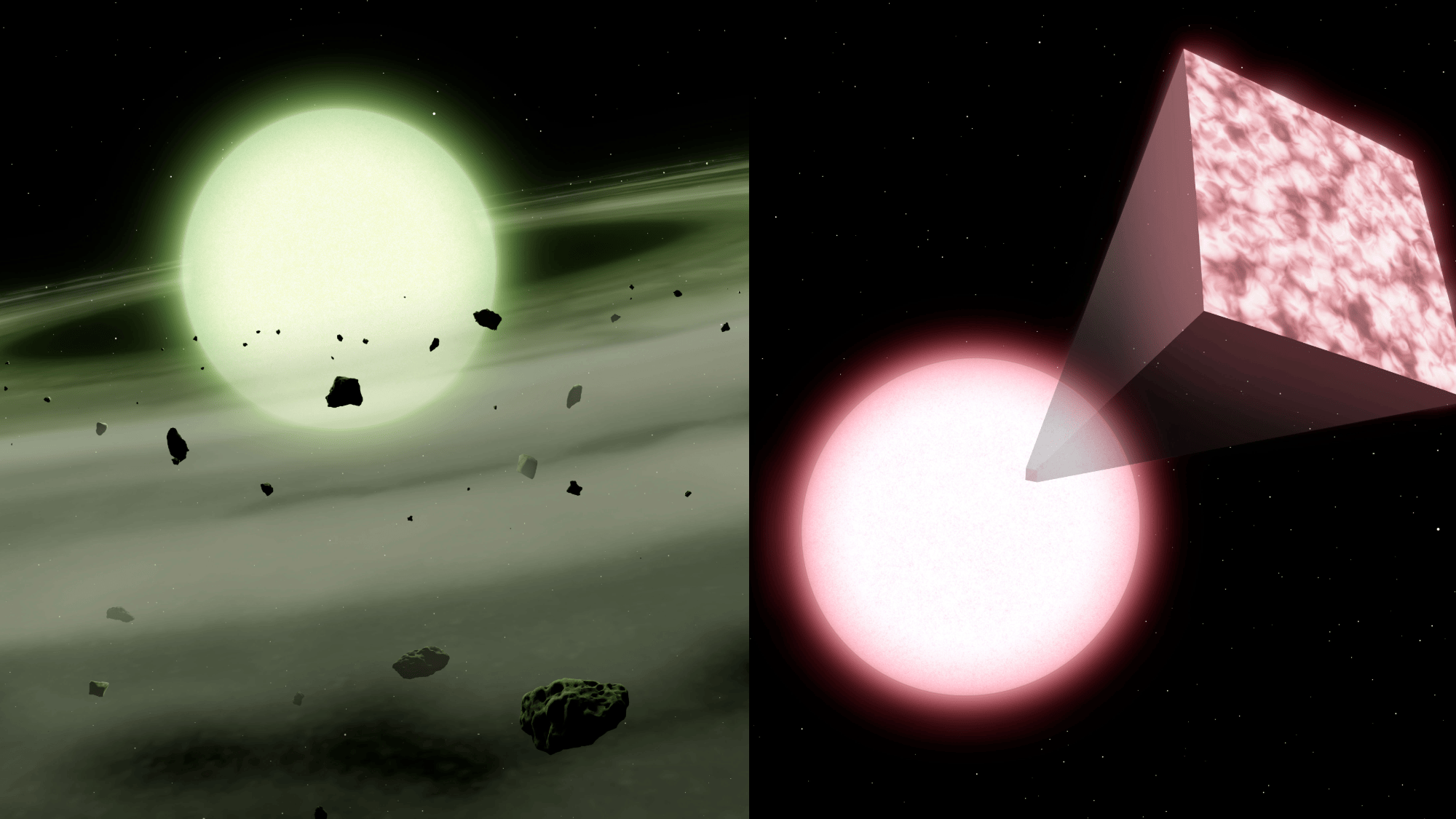
Despite the name, the universe’s white dwarfs can glow in a wide range of colors—even green. For the first time, astronomers have spotted a star that appears green to the human eye, and the reddest ever recorded. These outlier stars help explain how certain white dwarf stars would shine in green, pink, cyan, yellow, and purple if we actually saw them up close in space. These colorful findings are described in a study recently published in the journal RAS Techniques and Instruments.
Looking for the ‘perfect radiator’
White dwarf stars are the dense remnants left behind after stars like our sun reach the end of their lifespan. For most stars, their color gives a hint to their temperature. Cooler stars appear orange, warm stars like our sun look white. The hottest glow pale blue, similar to how a blacksmith’s iron will go from red to orange to white hot. Astronomers believed that white dwarfs followed this same rule. They even earned their name after the earliest examples were surprisingly hot and glowed in a white/pale blue.
“Most stars, including most white dwarfs, behave like ‘perfect radiators,’ so their colour is set almost entirely by temperature. But nobody had really looked into what else might be possible for white dwarfs,” Mark Hollands, a study co-author and astronomer at the University of Warwick in England, said in a statement. “It turns out these incredibly dense stars can produce colours nobody expected, and some of them genuinely surprised me.”
According to the team, the key to these colors is density. The atmospheres surrounding the coolest white dwarfs can reach about the same density as water (roughly 1 gram per cubic centimeter). They are also millions of times denser than the sun’s photosphere, the lowest layer of its atmosphere. Under these higher density conditions, any trace elements present (carbon, calcium, sodium, etc.) interact with the surrounding dense helium plasma. As they interact with the plasma, they can absorb light across a wider spectrum of colors than they would at lower densities. This then shifts the star’s color away from the more typical orange, white, and blue.
Unfortunately, no white dwarf sky is close enough for its color to be seen directly. Instead, the team calculated their color from data astronomers routinely collect—a star’s spectrum. The spectrum is a “fingerprint” that’s produced when starlight splits apart by wavelength, similar to how a prism splits sunlight into a rainbow. Astronomers ran these spectra through a computer model of what colors human vision can see to check what color a star’s light would appear to our eyes.
The first green and the reddest red
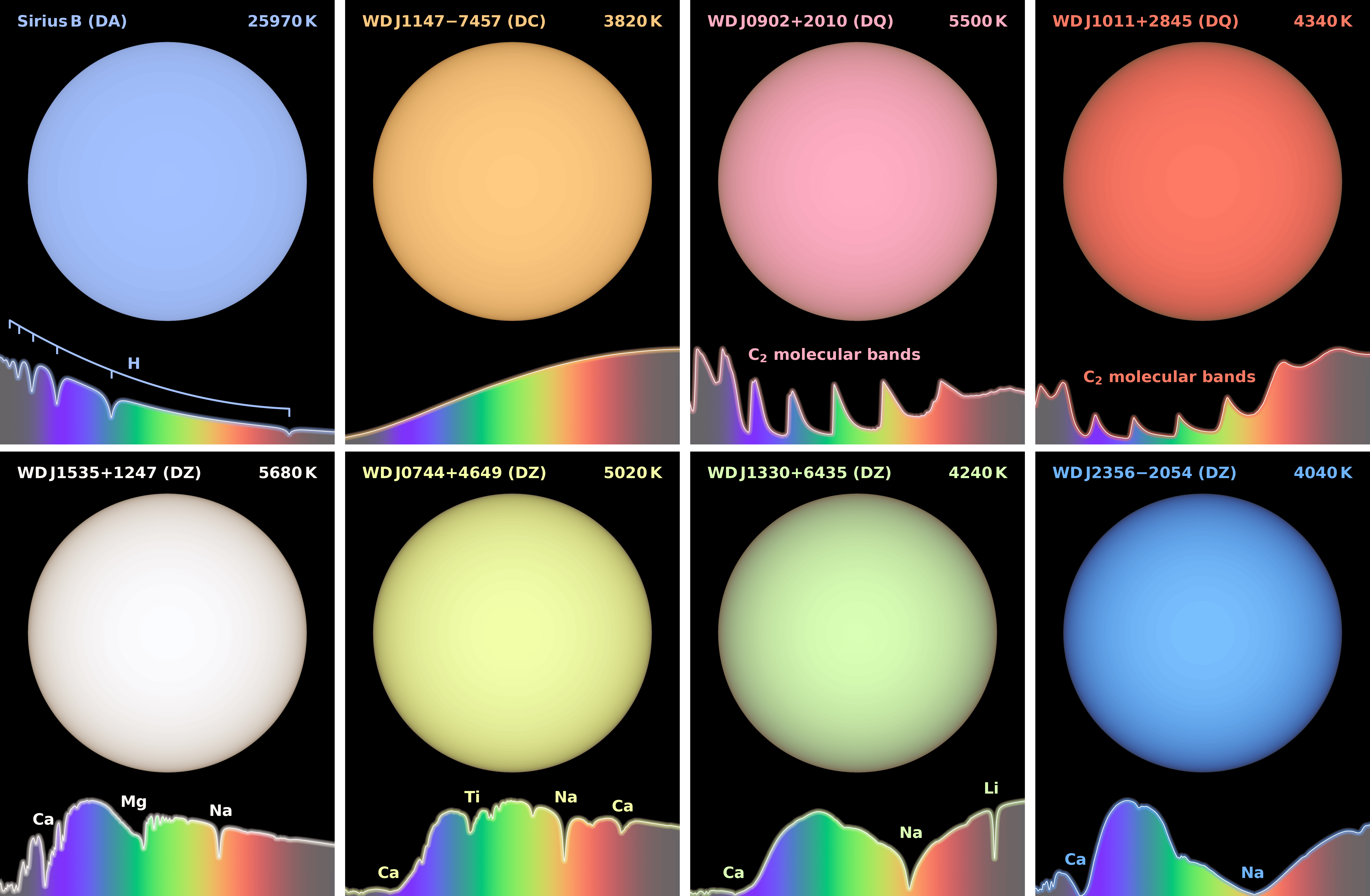
The team applied this method to several white dwarfs across the cosmos. They found that their colors fall into distinct groups linked to what makes up a star’s atmosphere. Carbon-rich white dwarfs generally appear pink or purple. Stars enriched with debris from busted asteroids and comets, the remains of old planetary systems, tend to be more yellow. Cooler white dwarfs with atmospheres of mixed hydrogen and helium show a more cyan or pale blue tinge. This cyan-pale blue is caused by hydrogen molecules colliding with helium atoms inside their ultra-dense atmospheres.
The most striking example is WD J1330+6435. This star is about 7,232 degrees Fahrenheit (4,000 degrees Celsius) and around 284 light-years away from Earth. Over time, it has gathered rocky material from its planetary system. All of this extra material enriched its atmosphere with calcium, lithium, and sodium. The result—a chartreuse green appearance in the team’s models. As far as the researchers are aware, no other star (living or dead) has ever been credibly reported as green.

“The traces of sodium in the atmosphere of this white dwarf absorb the orange part of the spectrum, leaving behind a ghostly green glow,” added Hollands. “Imagine standing on a planet and looking up at a green star. It feels like something out of science fiction.”
On the opposite end of the spectrum, the team identified what could be the reddest star ever recorded—WD J1011+2845. This white dwarf is only 48 light-years away from Earth, and has a deep convection zone. This zone is full of carbon that’s been lifted up from the star’s core to its surface. The carbon molecules then distort the star’s light so much that almost all of it is squeezed into wavelengths beyond 600 nanometres. This wavelength produces an unusual deep salmon-pink glow.
What are the odds?
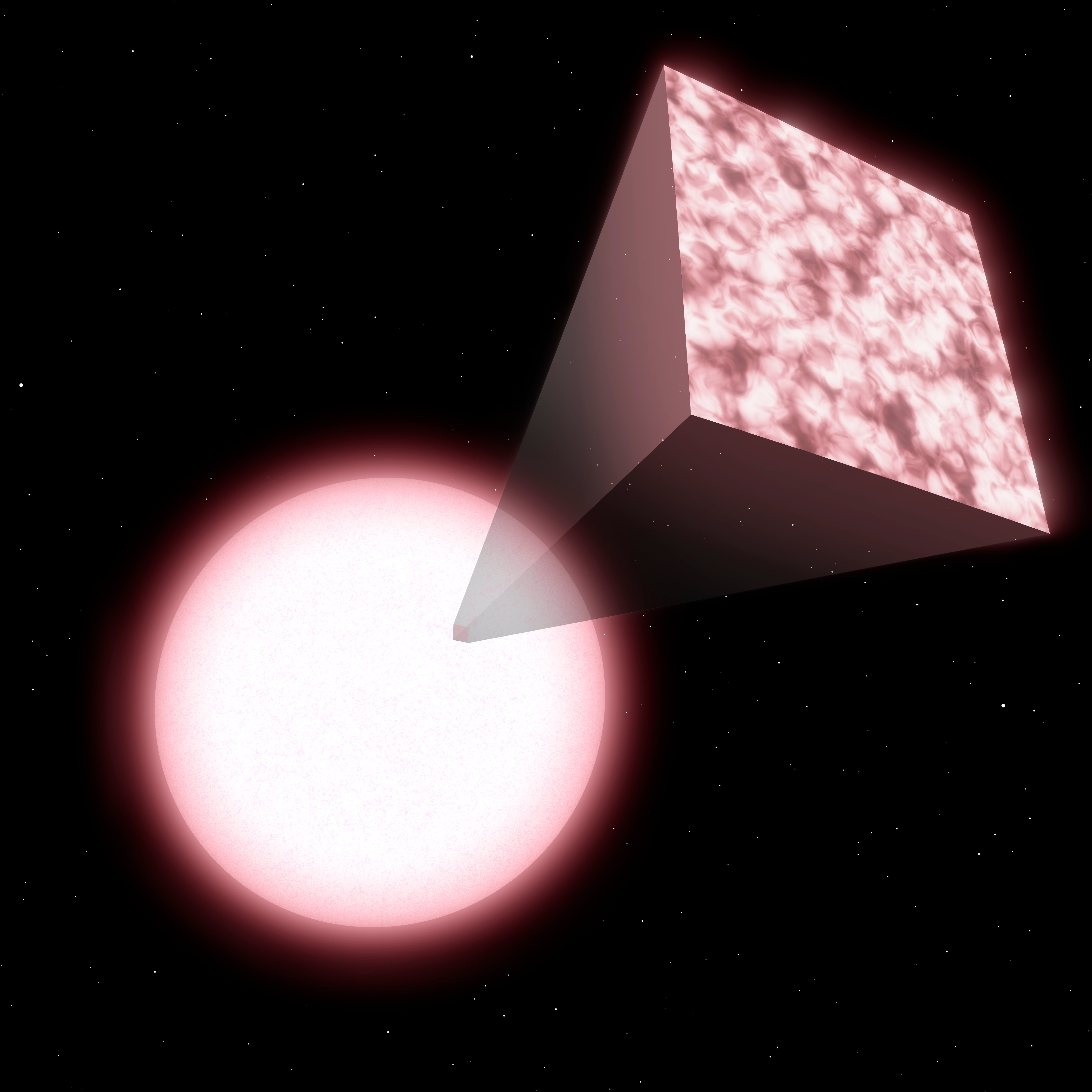
The team also studied 151 white dwarfs located within about 65 light-years (20 parsecs) from Earth. Only five of these showed unusual colors, two yellow and three pink. This suggests that about 1 in 30 of the universe’s white dwarfs shine with an unusually colored light.
The team then measured the color temperature of the remaining 146 white dwarfs. Color temperature is commonly used to describe light bulbs using degrees Kelvin—warm white at 3,000K, cool white at 6,000 K, etc. The median color temperature of the sample was approximately 6,800K, which our eyes perceive as white. This measurement corrects a common misconception that white dwarfs are typically blue. The hotter and bluer white dwarfs are mostly brighter, so they can be seen from further away and are over-represented in surveys that only look at a star’s brightness.
“One in thirty might not sound like a huge fraction, but across the entire population of white dwarfs in the Universe, that is still a lot of oddly coloured stars out there,” added study co-author and University of Warwick astronomer Boris Gänsicke. “Yet if we take the median across a representative population of white dwarfs, we found that the average white dwarf really is white.”
The post Astronomers discover first green star and the reddest star ever recorded appeared first on Popular Science.