
It’s that time of the year again. No, not the Super Bowl or the Academy Awards—it’s time to announce the finalists for the 28th annual Guthman Musical Instrument Competition. From March 13-14, creators from around the world will assemble at Georgia Tech in Atlanta to demonstrate their unique, innovative, and frequently bizarre music-making contraptions.
The top ten selections include entries from Australia, Poland, India, and the United Kingdom, but all of this year’s instruments push the boundaries of musicality, performance, and artistry in new, unexpected ways. This year, entrants include the seven-foot-tall synthesis of a double-bass and the classical Indian instrument known as a rudraveena, a “cyborg woodwind,” as well as a device that converts the invisible electromagnetic waves all around us into a “scientific séance.”
Last year’s first-place winner, the Chromaphone, was a collaborative project that utilized a simple, flat surface to generate synthesizer tones. It remains to be seen what will take the top spot and a $10,000 prize in March, but it’s gonna be hard to top last year’s Dinosaur Choir.
Take a look at this year’s contestants below. (Click to expand images to full screen.)
The Amphibian Modules

This modular synth swaps patch cables for a pool of salt water. Its engineering forces components to communicate through liquid, creating a “liquid circuit” where chemical currents and ripples shape the signal. The result is evolving, organic audio that behaves more like a living organism than a machine.
The Demon Box

A device that turns the invisible electromagnetic world into an instrument of “scientific séance.” Using a grid of 33 inductors, it captures frequencies from everyday electronics—like phones and drills—converting them into 3-channel audio, MIDI, and control voltage. Its triphonic design allows performers to “bow” or “strike” the signals of the modern world to sculpt everything from melismatic drones to synesthetic visuals.
EV

This isn’t just an electric violin; it’s a computer disguised as fine lutherie. Built with a curly maple body and four embedded Bela Mini computers (one per string), it uses infrared pickups to analyze every nuance of a bow stroke. The result is a seamless fusion of acoustic warmth and digital synthesis that responds instantly to the player’s touch.
Fiddle-Henge

A towering robotic sculpture that mounts four green violins around a bass drum. Instead of human hands, a motorized spinning disk acts as an “infinite bow,” while servos tilt the instruments to switch strings. It blends 3D-printed tech with antique automata, generating everything from stuttering mechanical rhythms to endless, meditative drones.
Gajveena

Standing nearly seven feet tall, this “bass-veena” hybrid fuses a double bass with Indian classical design. Its hollow neck acts as a sound conduit, channeling audio to a second resonator right by the player’s ear. Engineered with curved brass frets, it allows massive, microtonal string bends previously impossible on a bass.
Kalíptera

A “winged” hybrid that evolves the kalimba into a semi-autonomous digital instrument. Its dual resonance boxes are connected by an articulated hub, mapping the opening and closing motion of the “wings” to complex sound processing. Using real-time spectral analysis inspired by George Lewis’s Voyager, the instrument generates its own musical responses to create a non-hierarchical duet between the performer’s physical gestures and the machine’s digital brain.
The Lethelium

Built around a bicycle wheel rim, this 24-string instrument looks like an alien artifact. It spins on a cymbal stand, allowing musicians to strike, pluck, or bow its “spokes” to create sounds ranging from a harp to a steel drum. It’s an upcycled, industrial sound machine that turns scrap metal into a chromatic orchestra.
The Masterpiece

Shaped like a puzzle piece, this open-source synth prioritizes accessibility without sacrificing power. It uses pressure sensors rather than touch, allowing it to be played with any object or assistive device. Users change sounds by swiping RFID-tagged fabric swatches, helping players with disabilities build auditory-tactile connections while creating complex, polyphonic loops.
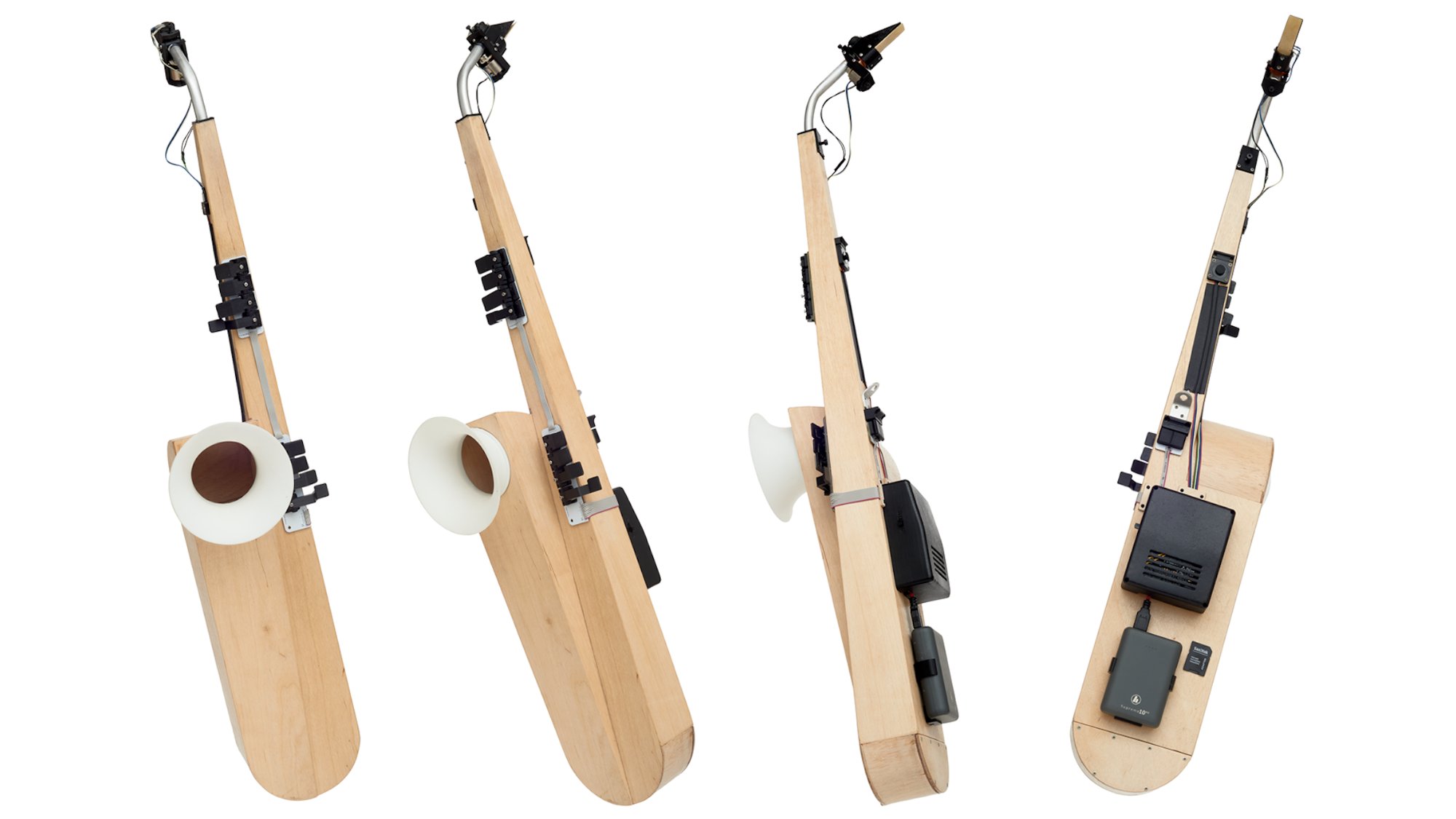
Post-Digital Sax

A cyborg woodwind that merges a real vibrating reed with a digital brain. Instead of tone holes, electromagnets manipulate the reed to change pitch, allowing for impossible notes and infinite bass. It combines the raw, acoustic feel of a sax with joystick-controlled looping and digital manipulation.
VERTO

Imagine a Hammond organ played with “The Force.” You wear magnetic pickups on your fingertips and hover them over spinning tonewheels to generate sound. This purely analog instrument turns proximity into volume and pitch, letting you sculpt electricity directly with the wave of a hand—no physical contact required.
The 28th annual Guthman Musical Instrument Competition will take place March 13-14 at the Georgia Institute of Technology in Atlanta.
The post The 10 weirdest and wildest musical instruments of 2026 appeared first on Popular Science.