
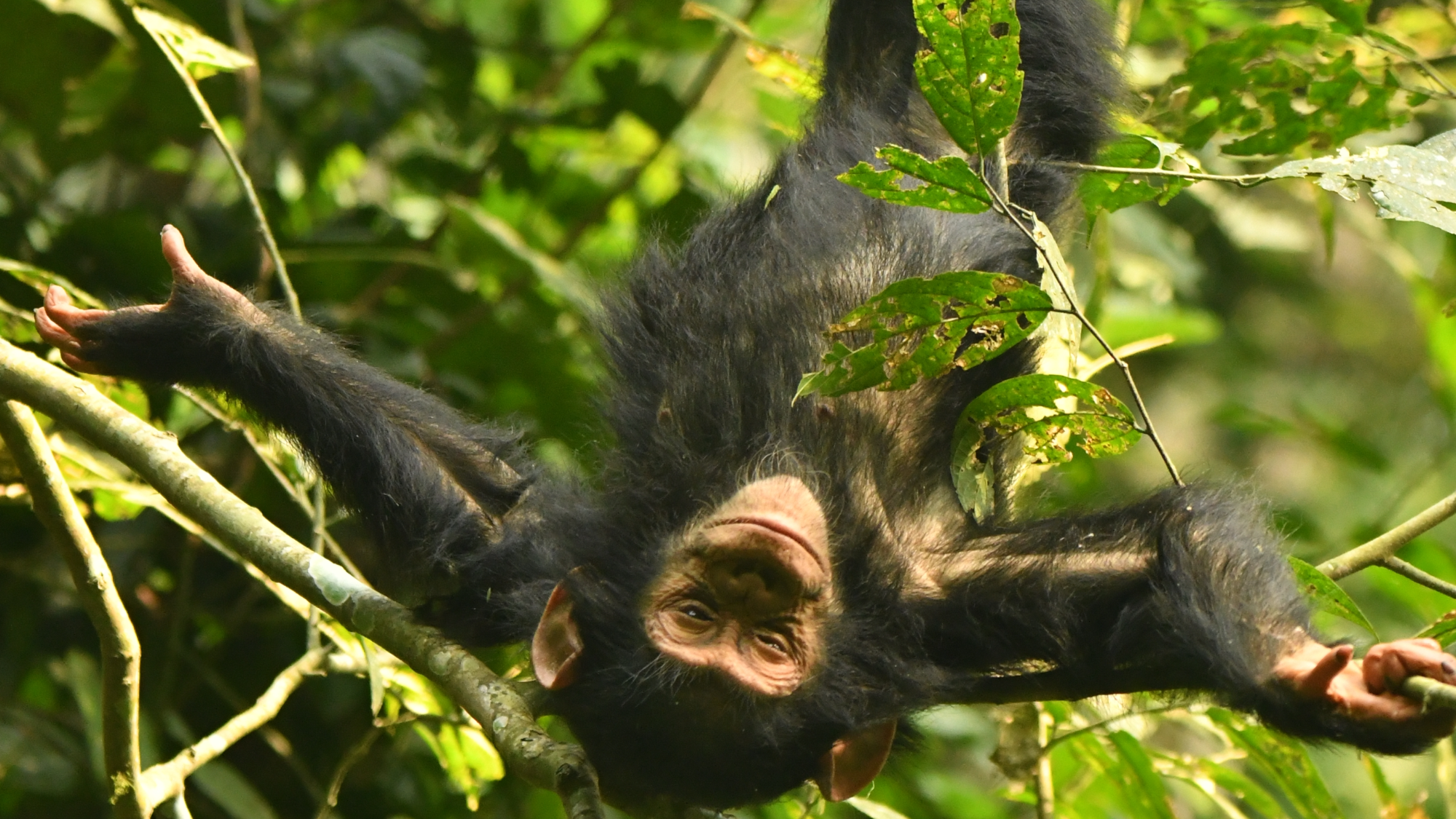
Given the many similarities between humans and chimpanzees, one might assume that both species similarly engage in risky behavior within the same age range. For humans, that’s obviously adolescence. However, according to a study recently published in the journal iScience, it turns out that in chimps, it’s the infants you have to watch out for.
After studying videos of 119 wild chimpanzees, researchers found that chimpanzees’ risky behavior peaks in their infancy, and then lessens as they get older. Specifically, they documented that infants were three times more likely, juveniles were 2.5 times more likely, and adolescents were 2.1 times more likely than adults to undertake risks. Chimps are typically classified as infants from birth to around five years old.
“One of the main findings is that all chimpanzee kids are risky, and that infant and juvenile chimpanzees are even more risky than adolescents,” Lauren Sarringhaus, lead-author of the recent study and a biologist at James Madison University, said in a statement. “That’s noteworthy because that is not what you see in humans.”
Chimps’ risk-taking was not associated with their sex, nor how high up in the trees they were. In other words, it was equally probable for male and female infants to undertake physical risks at any height. The specific risky behavior studied in chimps was free flight—when they purposefully fall from a branch or jump from one branch to the next without any hold.The risk in free flight is falling and then getting hurt.
Compared to chimpanzees, it’s more difficult to investigate physical risk-taking in humans. We can’t recreate the behavior in a lab, but even studies based on observations or survey data run into the issue that risky behavior in children (such as doing monkey bars) doesn’t usually continue into adulthood (such as skydiving), and vice-versa.
Interestingly, this study appears to suggest something novel about our own species. Simply put, the results indicate that while chimp mothers can only restrain their children as long as they can maintain them physically close, human parents and caregivers can continue monitoring them and human children are simply supervised more. What’s more, if we didn’t have this extended overwatch, our risky behavior might also peak earlier instead of being delayed to adolescence.
“Bryce found that in fact the youngest chimps were doing all of these crazy leaps and drops, and it declined gradually as they aged. We were really scratching our heads thinking, ‘What is going on?’”said co-senior author Laura MacLatchy, a professor of anthropology at the University of Michigan, referring to co-author Bryce Murray. “We realized that the littlest chimps were unrestricted in what they do, as soon as they were out of arm’s reach of their mom and no longer clinging and riding around on their mom.”
According to indications by earlier work, chimpanzee play might help them exercise abilities related to movement, or understand the results of risky behavior during a particular period of their lives—they are young, lightweight, have “spongier” bones, and have fewer chances of injury
Indeed, infant chimps frequently take the risks in question while playing, MacLatchy explained, to gain the physical competencies and confidence necessary for an arboreal existence. “Competency as an adult really depends on practice when you’re little,” she added. “Play as practice might be part of what’s going on with these kids. Then again, there may be no stopping them.”
The post Baby chimpanzees like to free fall through trees appeared first on Popular Science.