
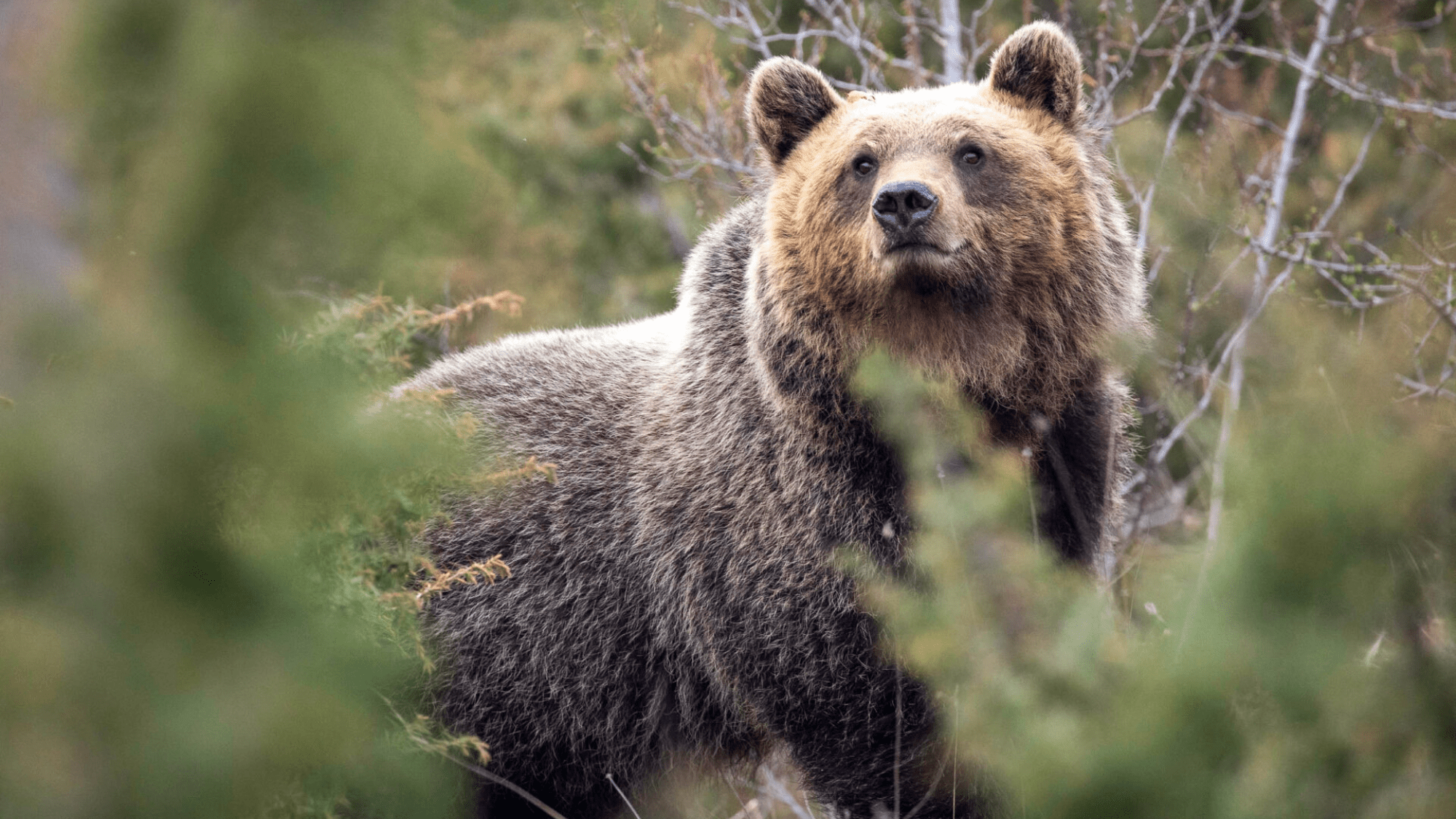
While bear attacks seem to have become a significant problem in Japan—with the country going as far as deploying the army—new research reveals that an Italian bear species has evolved to be less aggressive.
Apennine brown bears (Ursus arctos marsicanus) have been in close contact with humans for generations. Their small, endangered population exists only in central Italy, and previous research suggests that this population split off from other European brown bears 2,000 to 3,000 years ago. As a result, they have been thoroughly isolated from other bears since the days of the Roman Empire. Compared to European, North American, and Asian brown bears, Apennine brown bears have distinctive facial and head traits, smaller bodies, and are less aggressive.
“One major cause of decline and isolation,” Andrea Benazzo, a biologist at the University of Ferrara, said in a statement, “was probably forest clearance associated with the spread of agriculture and increasing human population density in Central Italy.”
Related Bear Stories
Benazzo is lead author of a study recently published in Molecular Biology and Evolution. He and his colleagues from the University of Ferrara used genomic analysis to investigate how humans have recently changed the Apennine brown bear’s evolution. They found, unsurprisingly, that Apennine brown bears exhibited less genomic diversity and greater inbreeding than other brown bears due to their isolation.
“More interestingly, however,” added Giulia Fabbri, a study co-author and molecular biologist , “we showed that Apennine brown bears also possess selective signatures at [the] genes associated with reduced aggressiveness.”
Their results indicate that the selection of behavior-related genetic variants—probably induced by humans eliminating bears with greater aggression—promoted a significantly less aggressive population of bears. They also suggest what might seem like a paradox.
“The general implications of our findings are clear,” said study co-author and geneticist Giorgio Bertorelle, “human-wildlife interactions are often dangerous for the survival of a species, but may also favor the evolution of traits that reduce conflict,” he added. “This means that even populations that have been heavily and negatively affected by human activities may harbor genetic variants that should not be diluted.”
The post Bears in Italy inbreed more, but are less aggressive appeared first on Popular Science.
Can you be more specific about the content of your article? After reading it, I still have some doubts. Hope you can help me.
Thank you for your sharing. I am worried that I lack creative ideas. It is your article that makes me full of hope. Thank you. But, I have a question, can you help me?