
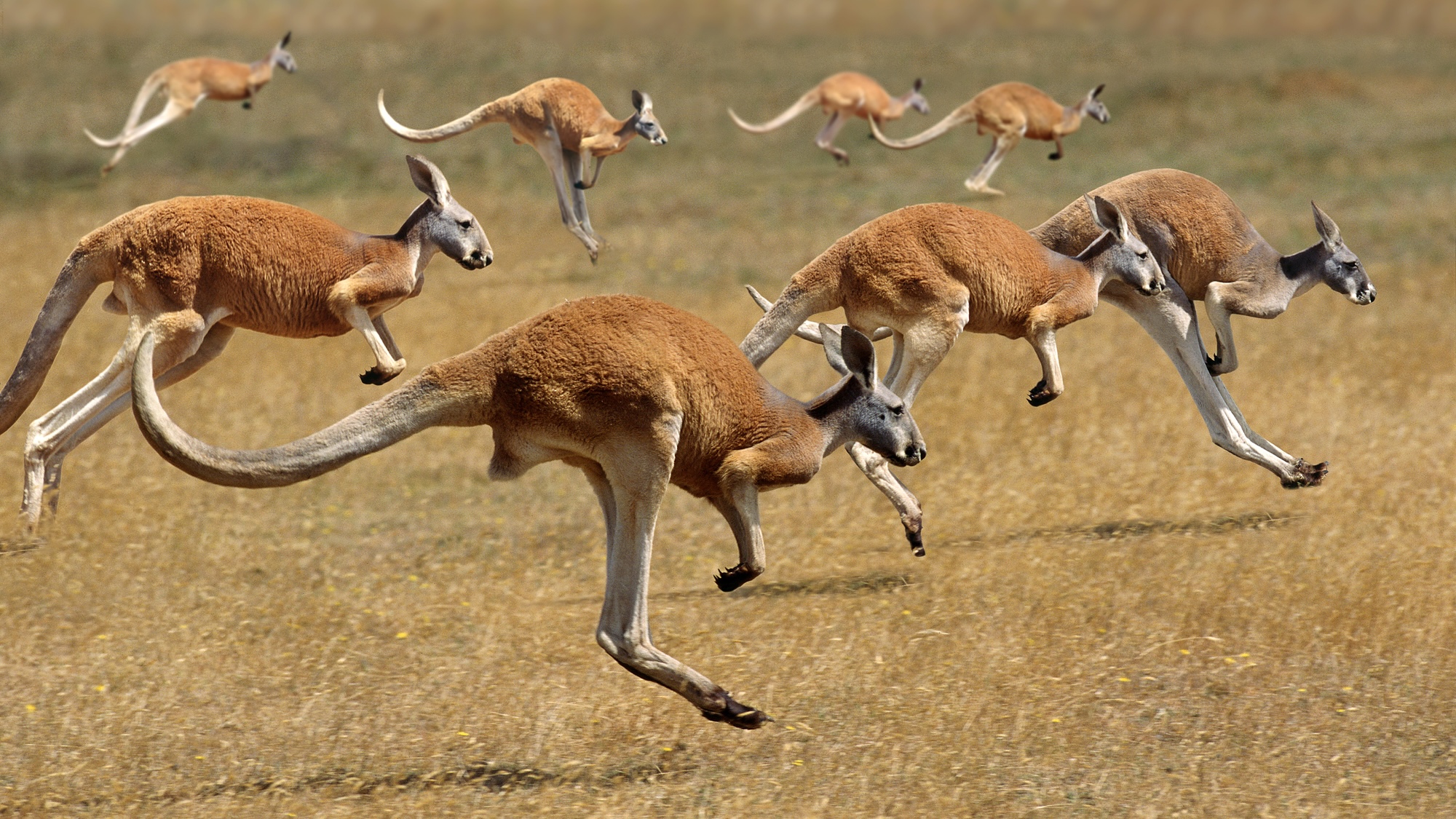
Kangaroos have likely been hopping across the planet for much longer than experts previously believed. Not only that, but the ancestors of today’s marsupials landed their leaps while growing much larger than their descendents.
For thousands of years, the planet’s largest hopping animal has remained Australia’s red kangaroo (Osphranter rufus). A male “Big Red” easily reaches over five feet tall, weighs 200 pounds, and travels around 37 mph at a pace of up to six feet per leap. But as big as they are today, their evolutionary relatives were even heftier. During the Ice Age around 45,000 years ago, giant kangaroos in the Sthenurinae subfamily often grew over double the size of present-day marsupials. Paleontologists estimate the largest, Procoptodon goliah, stood 6.5 feet tall and weighed upwards of 550 pounds.
It’s easy to assume P. goliah and other giant kangaroos lost their ability to hop as a result of all that bulk. After all, scaling up the anatomy of a Big Red suggests the physical act becomes mechanically impossible above 330 pounds. But according to University of Manchester evolutionary scientist Megan Jones, that has been the problem.
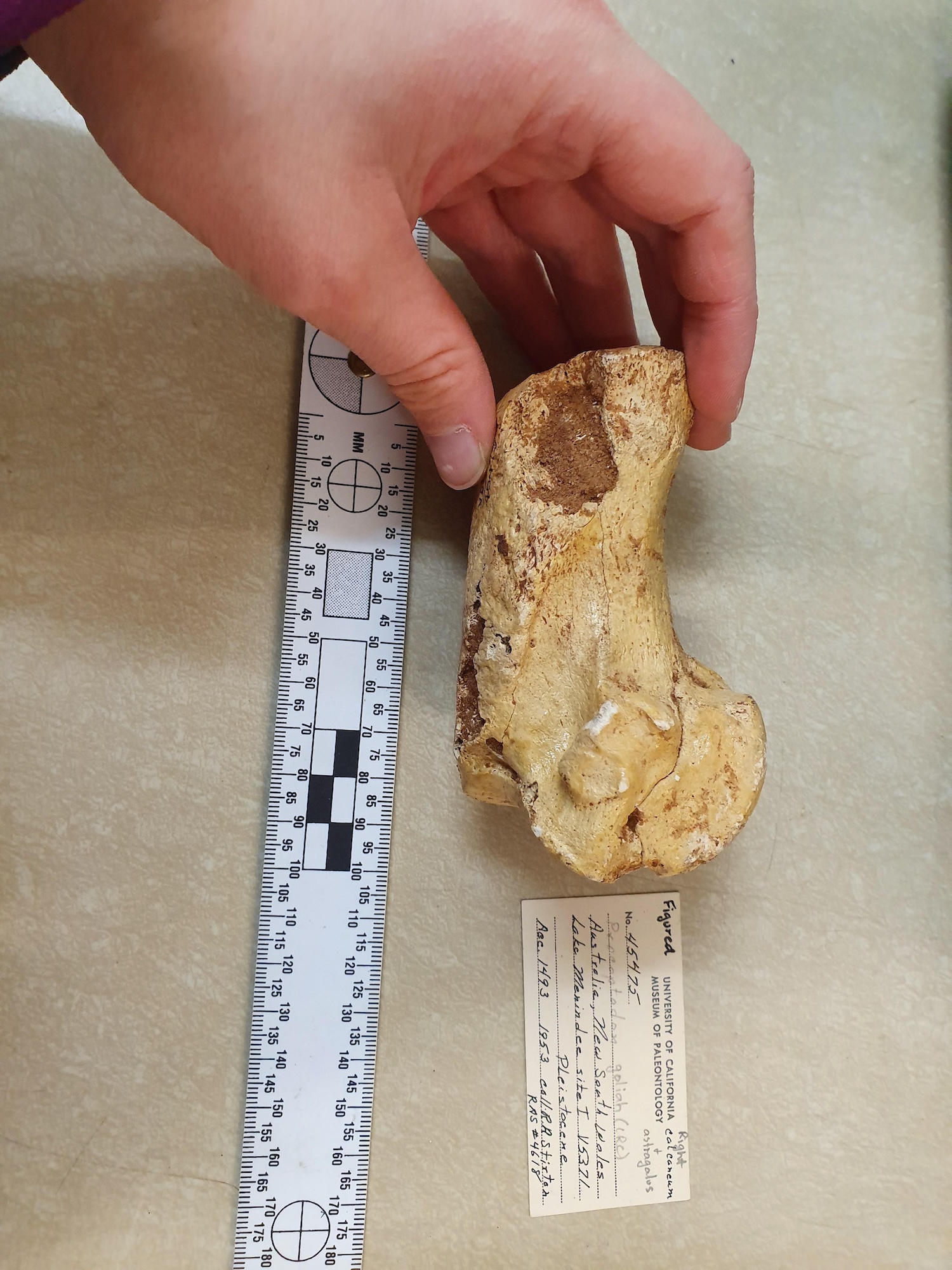
“Previous estimates were based on simply scaling up modern kangaroos, which may mean we miss crucial anatomical differences,” Jones said in a statement. “Our findings show that these animals weren’t just larger versions of today’s kangaroos, they were built differently, in ways that helped them manage their enormous size.”
In a study published today in the journal Scientific Reports, Jones and colleagues lay out the case for a new look at the giant ‘roos of the Ice Age. Their conclusions come from comparing present-day kangaroo skeletal anatomy with the fossils of their marsupial cousins. The team specifically focused on two primary limitations for hopping: foot bone strength and how an ankle could support strong enough tendons to facilitate locomotion.
Read more about megafauna
Unlike today’s kangaroos, the Sthenurinae megafauna possessed thicker, shorter foot bones and broader heels. This combination likely allowed them to handle the intense downward force of hopping with the help of powerful tendons. At the same time, giant kangaroos almost certainly weren’t constantly hopping across ancient Australian landscapes.
“Thicker tendons are safer, but they store less elastic energy,” said University of Bristol biologist and study co-author Katrina Jones. “This likely made giant kangaroos slower and less efficient hoppers, better suited to short bursts of movement rather than long-distance travel.”
Jones added that their intermittent hops weren’t simply impressive displays of talent. The giant kangaroos could use them to traverse difficult terrain more easily, or escape imminent danger from predators.
It wasn’t all hopping or walking, either. Analysis of other Sthenurinae fossils suggest a variety of movement options for different giant kangaroo species. The study’s authors theorize some may have hopped for short distances, then walked on either two or all rfour legs as part of a wider “movement repertoire.”
The post 550-pound Ice Age kangaroos could still hop appeared first on Popular Science.