
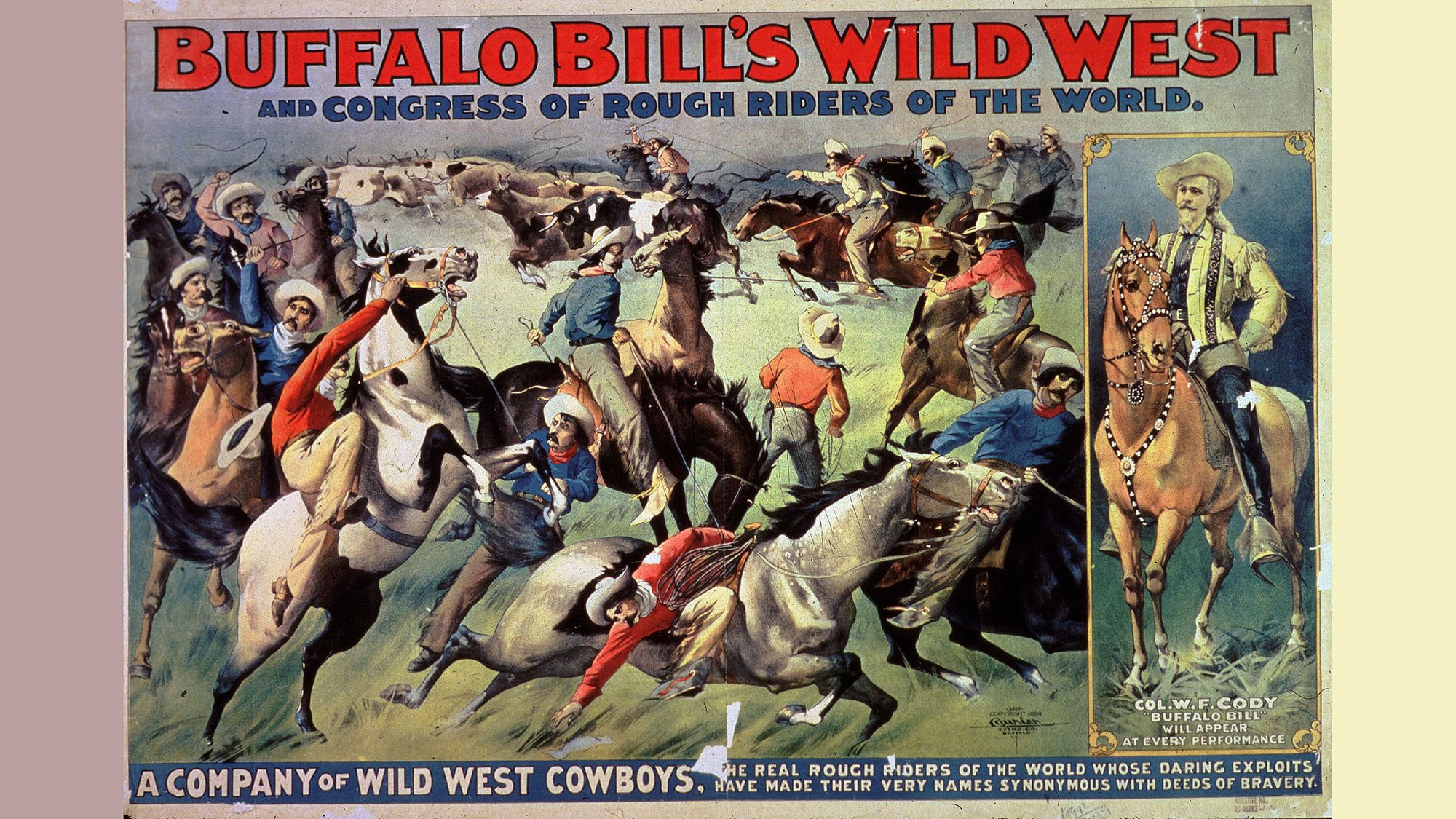
The French president and his wife were among the audience of thousands at the debut performance of Buffalo Bill Cody’s Wild West Show at the 1889 Paris World’s Fair.
Cody’s raucous tribute to the golden age of the American West was already a huge sensation in the United States. In 1887, the show had taken the United Kingdom by storm. But the French weren’t quite sure what to make of the Lakota Sioux warriors and lanky cowboys as they came whooping into the outdoor arena, spurring their horses into streaks of lightning. Even one of the show’s most popular acts—the rescue of a stagecoach ambushed by Native Americans—left them cold.
Then, Annie Oakley skipped into the arena and launched into her act, her guns shattering a flock of glass balls thrown into the air. When her bullets were spent, she threw the pistols like hot irons and grabbed another. The audience roared to life.
Buffalo Bill Cody’s Wild West Show was “a great success in every way,” declared the front page of the Paris Herald the next day. Within weeks, the French capital had been infected by “Wild West Fever.”
The “Savage Indian” turned French celebrity
By the late 1880s, a deep nostalgia for an American West full of “savage Indians” and “noble pioneers”—a place that, by then, existed only in memory due to the brutal policies of the U.S. federal government against Native Americans—had settled into the American consciousness.
Europeans, too, were intrigued by the idea of the vast plains and their “primitive Indians.” Indigenous people had been displayed in Paris for decades, sometimes as performers on stage, other times as temporary residents of “living habitats” in the city’s zoological gardens. Close to 400 Indigenous individuals from French colonies were living on the main fairgrounds that same year. Early anthropologists—adherents of Social Darwinism, the ideology that all human groups occupied a rung of the evolutionary ladder between savagery and enlightened civilization—studied them as specimens in the science of race.
Parisians “had heard about the [American] Indians, but the Wild West Show was their first exposure,” says Steve Friesen, former director of the Buffalo Bill Museum and Grave in Golden, Colorado, and author of Galloping Gourmet: Eating and Drinking with Buffalo Bill. “They saw the real thing and they were impressed.”
Indeed, it wasn’t long before young Parisian women began flocking to the “Indian Camp” at the Wild West Show (the area where the performers lived, which was open to the public). Dozens stood waiting, ready to elbow one another out of the way to proffer cigarettes and coy smiles to the handsome, young Sioux warriors. Men, too, hung around, intrigued by the expert horsemen and sharpshooters. Cowboy hats and American- and Mexican-style saddles flew off the shelves of shopkeepers cashing in on the trend.
Popcorn sold at the show, unfamiliar to the French, became so popular that, soon, it could be found at the city’s other sites of entertainment. By October, five months after the debut of Cody’s company, “it was said that the people of Paris seem to go to the [any] theater just to eat popcorn,” Friesen laughs.
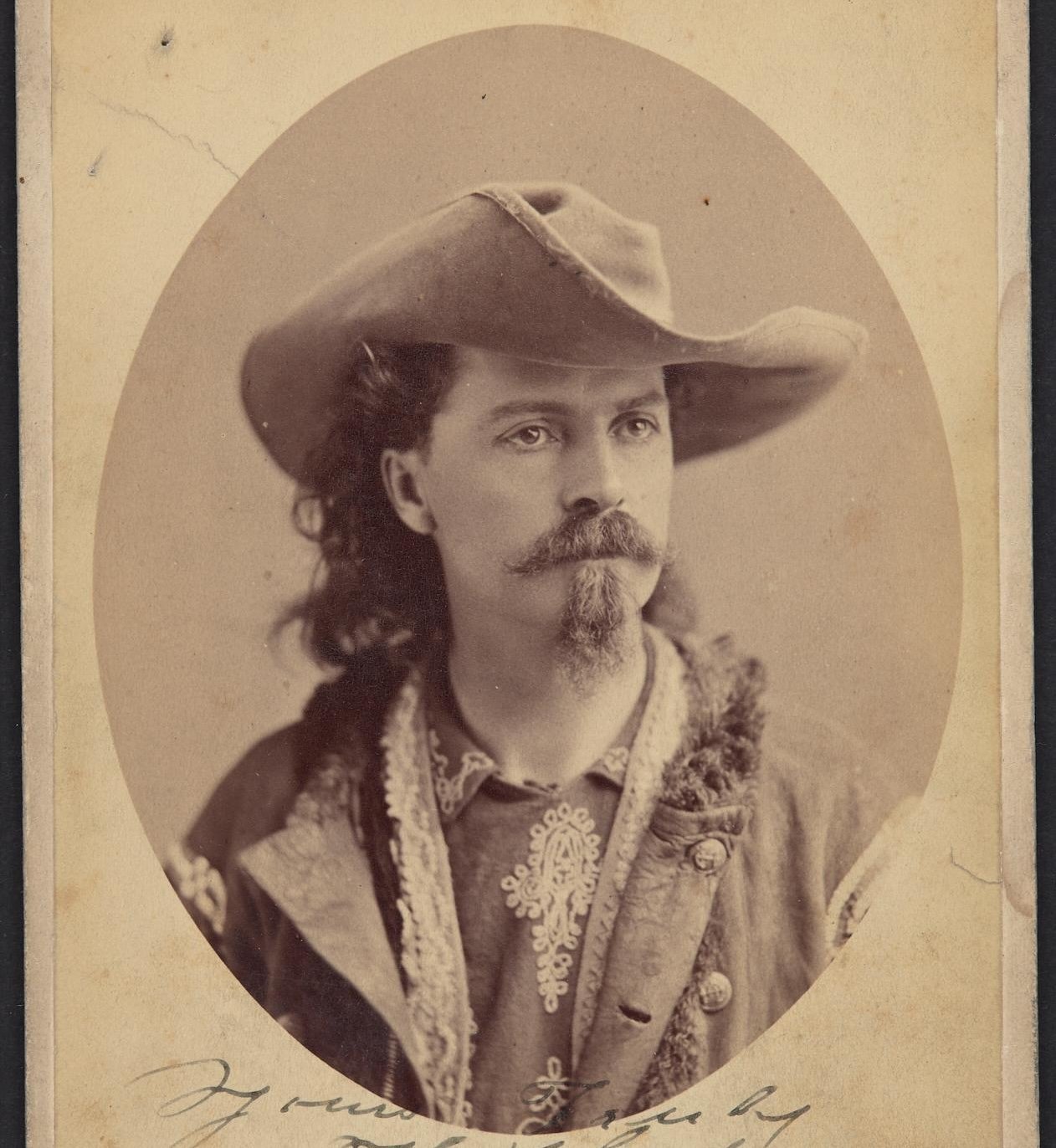
Buffalo Bill Cody—Guillaume Buffalo to the French—was the ideal ambassador for the legend of the American West. Back in his own country, he was already a major celebrity—an authentic cavalryman, scout, who claimed to have ridden for the Pony Express, as well as a stage actor known for his charisma and good looks.
Soon, “he became one of the darlings of Paris,” says Friesen. “Everybody wanted to meet him.” He, along with several of the Native American and cowboy performers, were often seen about town, at the theaters, and on the grounds of the World’s Fair, including climbing the Eiffel Tower, which was built for the event.
For six months, Buffalo Bill’s Wild West Show performed twice a day to a full-to-bursting 30,000-person arena that, despite being some distance from the core of the World’s Fair grounds, sometimes upstaged the main event. No one in town could get enough, including some of Europe’s most famous artists.
“Paul Gauguin went to the show once,” says Friesen. “He liked it so much he went a second time and then he went out and bought himself a Stetson hat. At the Musée d’Orsay, in a self-portrait he made in Tahiti, he’s wearing a hat that looks very similar.”
Edvard Munch visited; French painter Rosa Bonheur was a regular fixture at the Indian Camp, capturing the performers on canvas. It was also in Paris that Cody met Thomas Edison, who was at the fair to demonstrate new electrical technologies. A few years later, he put the showman and his Lakota performers into one of the world’s first motion pictures.
The Wild West lives on in Paris
“Buffalo Bill was basically the first emissary of the American West to France, telling people what the West was like,” Friesen says. The appeal was anything but fleeting. When the company returned for a six-month tour of the country in 1905, they reignited the “Wild West Fever” that had swept Paris 16 years earlier.
Today, the impact of that “fascination with the American West is certainly still being felt in the larger sense,” he continues.
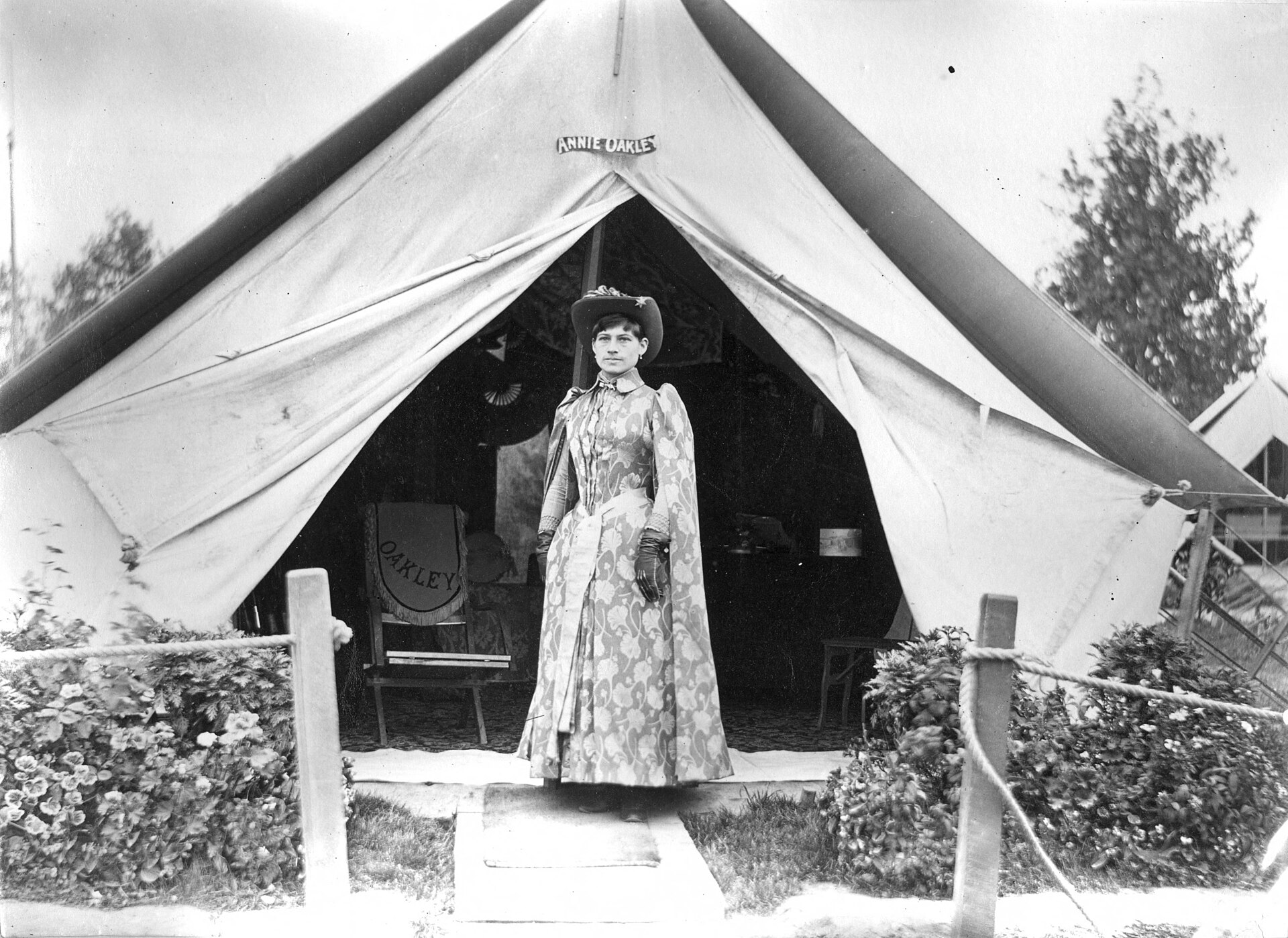
According to Friesen, the trend of women wearing cowboy hats with skirts, Annie Oakley’s signature style, likely began with the Wild West Show. The kind of “Western” shops that cashed in on the trend back in 1889 are still found in the city and beyond. There is even a French steakhouse chain called Buffalo Grill that has featured a portrait of Buffalo Bill in its logo.
While the French were skeptical when Disneyland Paris opened its doors in the early 1990s, one thing in the Disney Village was “turning a really good profit,” Friesen says: their knockoff Wild West Show.
“It had room for 2,000 people, twice a day, who would go in and eat American food—cornbread and steak and things like that. Everybody would get a straw cowboy hat and they’d watch a performance of Buffalo Bill kinds of acts,” says Friesen.
“The popularity, the name recognition of Buffalo Bill’s Wild West Show had enough of an impact that it remained all the way to the 2000s.”
In That Time When, Popular Science tells the weirdest, surprising, and little-known stories that shaped science, engineering, and innovation.
Related ‘That Time When’ Stories
Charles Darwin’s daughter had an unusual hobby: Hunting phallic mushrooms
The strange Wild West tale of the first cow-buffalo hybrid
Inventor Beulah Louise Henry’s unstoppable rise to becoming ‘Lady Edison’
Beef tea was all the rage in the 1800s
The CIA once trained cats to be Cold War spies
Andrew Jackson’s White House once hosted a cheese feeding frenzy
The post In 1889, Paris became obsessed with the Wild West appeared first on Popular Science.