
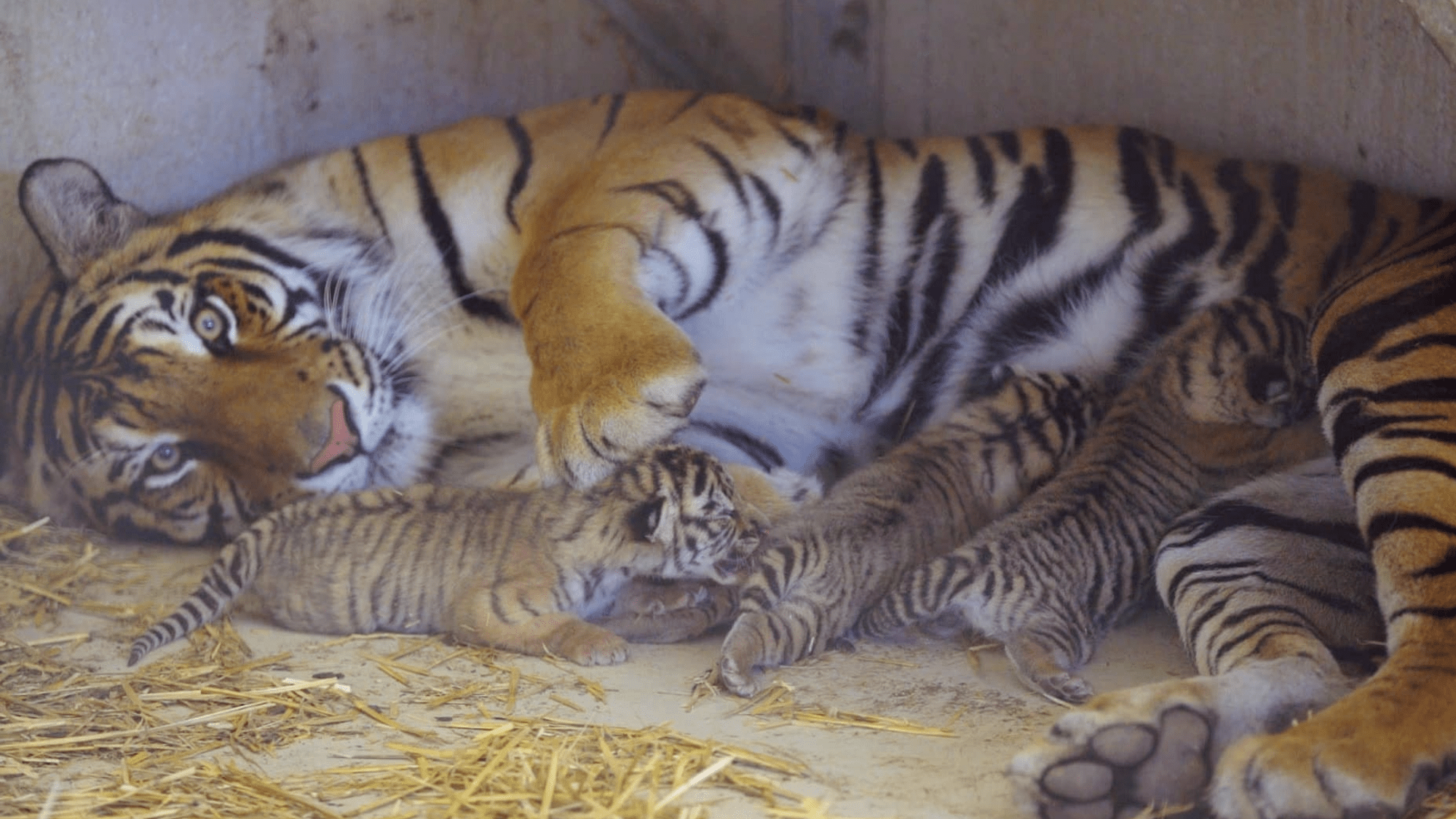
In a win for animal conservation, a Bengal tiger (Panthera tigris tigris) recently gave birth to three cubs at Tanganyika Wildlife Park in Goddard, Kansas. The new litter came into the world on June 11 and consists of three furballs—one female and two males.
Their mother, Sienna, is an orange tiger, while their father, Grayson, is a white Bengal tiger. All three cubs take after their mother’s orange hue. Given that white is a recessive trait in Bengal tigers, this doesn’t come as a surprise. The birth itself, however, was a bit of a surprise as it came with little warning.
Pregnant tigers don’t look all that different from their nonpregnant peers, especially first-time mothers. What’s more, the team at the Tanganyika Wildlife Park hadn’t yet seen a confirmed breeding between Sienna and Grayson. As such, they were only truly clued in when a keeper saw mammary development in Sienna during a training session.
“We saw some mammary development and realized we were most likely going to have babies,” Carnivore Supervisor Phoebe Andrews said in a statement.
The yet-unnamed cubs are the mother and father’s first litter. Sienna’s maternal instincts came out immediately, and she groomed her babies and allowed them to nurse shortly after birth. Nonetheless, animal keepers are hand-rearing the cubs.
“Hand-rearing is a deliberate choice,” reads the press release. “Newborn cats are fragile, and the park’s first priority is giving each cub the best possible chance at survival. Raising the cubs by hand lets keepers tailor nutrition to their needs, provide immediate medical care, monitor their health closely, and support healthy development through the most vulnerable stage of life.”
The trio spent their first weeks with their mother, and then was transferred to the nursery for full-time care. The keepers will weigh them, document their growth, and feed them several times a day. The siblings’ stripes are currently too alike to distinguish them visually. Instead, the animal keepers are using small fur trims as short-term identifiers.
Unfortunately, the Bengal tiger family’s counterparts in the wild are threatened by deforestation, habitat loss, poaching, and conflicts with humans. The International Union for Conservation of Nature (IUCN) Red List of Threatened Species classifies the species as Endangered.
“They’re still endangered in the wild. It’s important to maintain a population in professional care so we can keep that genetic diversity,” highlighted Samantha Russak, Curator of Research & Welfare and Registrar at the Tanganyika Wildlife Park.
The post Three tiger cubs born in Kansas appeared first on Popular Science.