
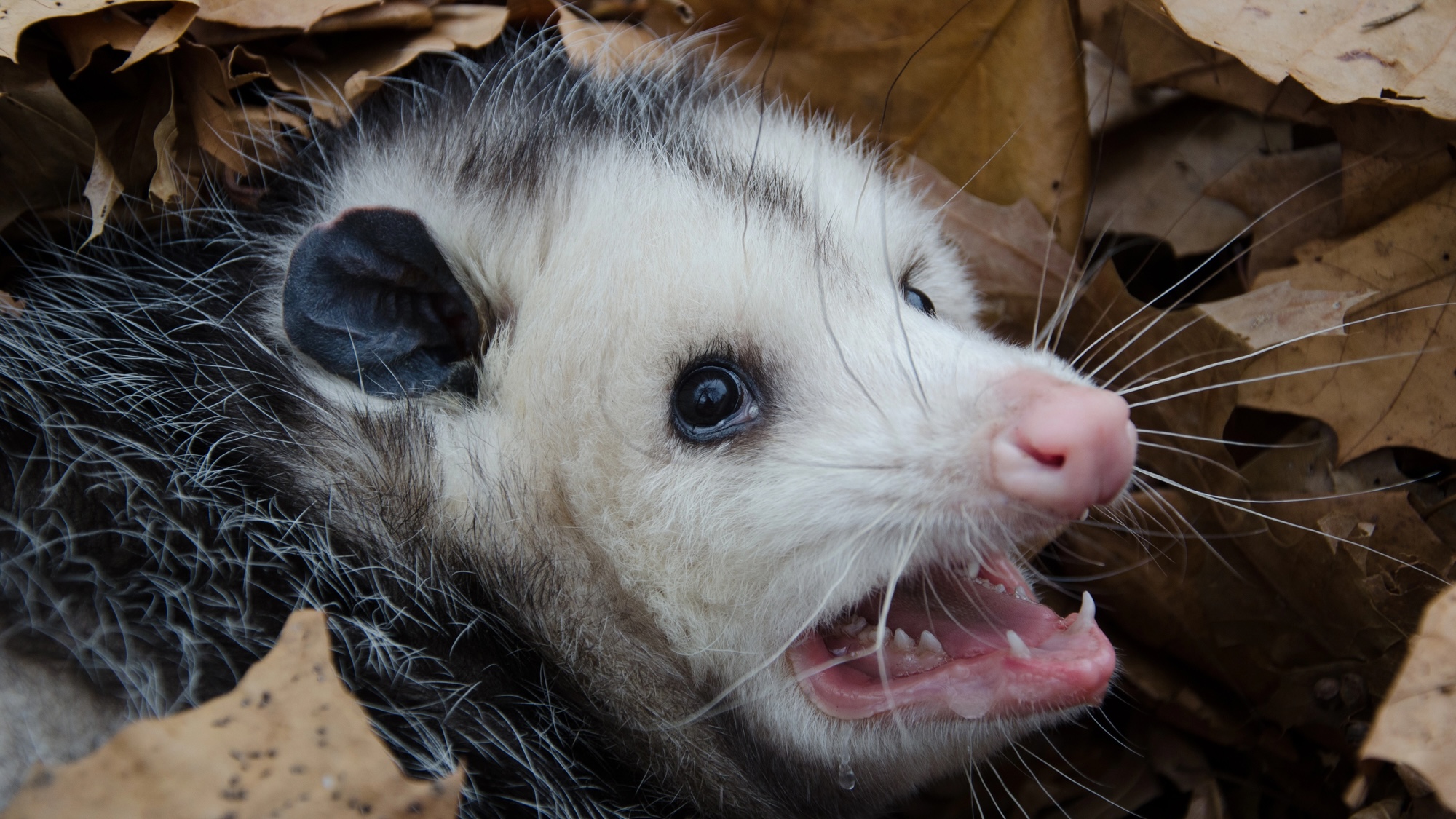
Some of Florida’s opossums may soon start dying for a noble cause. A few select marsupials fitted with tracking collars may begin to lead scientists to invasive Burmese pythons (Python bivittatus) slithering through the Everglades. More specifically, researchers will home in on signals coming from inside the enormous snakes’ stomachs.
Florida’s decades-long python problem remains one of the toughest ecological challenges facing wildlife conservationists in the United States. Despite experts’ best attempts to highlight their nutritional value and even hunt them using robotic rabbits, the snakes have continued to decimate native animal populations, since they were introduced into the Everglades during the 1970s.
Curtailing Florida’s unwanted apex predators is much easier said than done. Burmese pythons can grow upwards of 20-feet-long, and unlike humans, they are the species that is specifically evolved to thrive in subtropical wetlands. Local opossums, on the other hand, don’t have any problem traipsing through the marshy terrain the way we do.
In 2022, North Carolina Museum of Natural Sciences wildlife biologists A.J. Sanjar and Michael Cove traveled to Florida to survey the habits of opossums after fitting them with tracking collars. It didn’t take long before they ran into a problem: local pythons kept eating their study participants. Each felled opossum wasn’t only a lost source of information—it was expensive, too. At the time, each tracking collar cost about $1,500.
While the issue was annoying, it also prompted an interesting discussion. The pythons that ate the opossums were all euthanized as part of Florida’s conservation efforts. What if researchers intentionally deployed opossums with (much cheaper) tracking collars, then used them as bait for thinning python numbers?
After a few years of tinkering with the plan and securing additional funding including $190 collars, Sanjar and Cove are planning to use Crocodile Lake National Wildlife Refuge in Key Largo for their new opossum vs. python experiment. According to the South Florida Sun Sentinel, the researchers aim to enlist at least 40 opossums by later this summer. Given simple math and the area’s food chain, it’s a near certainty that some of the furry allies will meet their end in the tightening coils of an invasive python. However, instead of literally feeding the ongoing problem, their demise will help conservationists continue their work restoring a semblance of balance to the native ecosystem.
“We’re not putting these animals out there and in harm’s way,” Crocodile Lake National Wildlife Refuge manager Jeremy Dixon told the South Florida Sun Sentinel on April 19. “Harm’s way is there. We’re just documenting what’s happening.”
The post Scientists sacrifice delicious opossums to fight Florida’s invasive pythons appeared first on Popular Science.